
The Visone Stone
The Visone Stone is a biocalcarenite quarried from Roman times until the 1970s, used over the centuries both as cut stone and for the production of lime.
Known in recent historical memory as limestone due to the archaeological-industrial structures linked to its production, it has also been widely used as building and sculptural stone. The quarrying and use of Pietra di Visone has for centuries shaped the economy of the Acqui region, influencing the architectural style of the area.


Geological overview
The Visone Formation consists of an outcrop of biocalcarenite located in the Tertiary Piedmont Basin, between Visone and Acqui Terme. It is of regional importance because it represents a significant carbonate sedimentation event in the Miocene terrigenous succession of the Alto Monferrato, correlatable with other similar units, such as the Pietra da Cantoni and the Bismantova Sandstones, found in Monferrato and in the northern Apennines respectively.
In the latest update of the Geological Map of Italy it is divided into two members: the calcareous Member and the marly-glauconitic Member.
The calcareous Member constitutes the most widely exploited deposit, in turn subdivided into White Limestone and Grey Limestone, distinguished by different varieties of fossils which bear witness to the ancient presence of the sea in these areas.

Use
Visone Stone has been quarried since Roman times and used over the centuries both as cut stone and for the production of Lime.
Known in recent historical memory as lime stone, owing to the industrial-archaeological structures linked to its production, it was in fact widely used as a building and sculpture stone. The quarrying and use of Visone Stone guided the economy of the Acqui area for centuries and, at the same time, influenced its architectural style, playing a role quite different from that assigned to it by popular tradition, which regards it as a "poor" material.
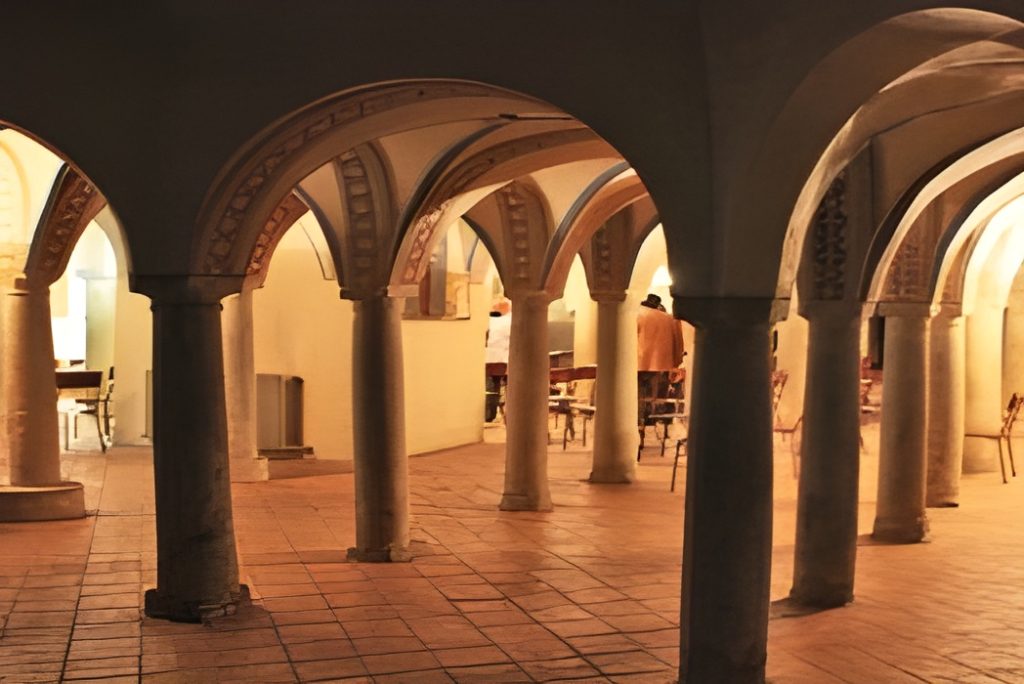
The use of Visone Stone, in its two varieties, white and grey, was widespread from the classical age up to the twentieth century, with an interruption in the medieval period, when the reuse of late Roman material is frequently attested, as in the case of the Crypt of the Cathedral of Acqui Terme. Nor does it appear in the ruins of the church of San Pietro (11th century) or in the fourteenth-century tower of the village of Visone itself. Indeed, it was not used in blocks for masonry work.
From the 15th century onwards there was a considerable revival in its use, particularly frequent in the decorative elements of noble palaces and churches, which reached its peak in the following century in monumental complexes such as Santa Croce in Bosco Marengo.
Its use is particularly recurrent in monolithic-shaft columns, employed in porticoes and loggias which thus became characteristic elements of the local formal architecture: in this sense, within southern Piedmont, Visone Stone certainly shaped a stylistic taste that is found nowhere else beyond the Acqui area.
Lime production
The earliest written evidence of lime production at Visone is attested by a document dated 1549, ordering the construction of one or more lime kilns. But we certainly need to go further back in time: the quarrying of Visone Stone, already used in Roman times as a sculpture stone, must surely have included its use as lime stone as well.
Traces of lime production appear in documents of the following centuries. At the beginning of the nineteenth century three quarries producing high-quality lime were in operation: that of the lawyer Carlo Giuseppe Rossi in the Quaretto district, that of Delorenzi-Bonello-Perazzo in the Fornaci district and that of Bonelli-Bocca in the Calcagno district.
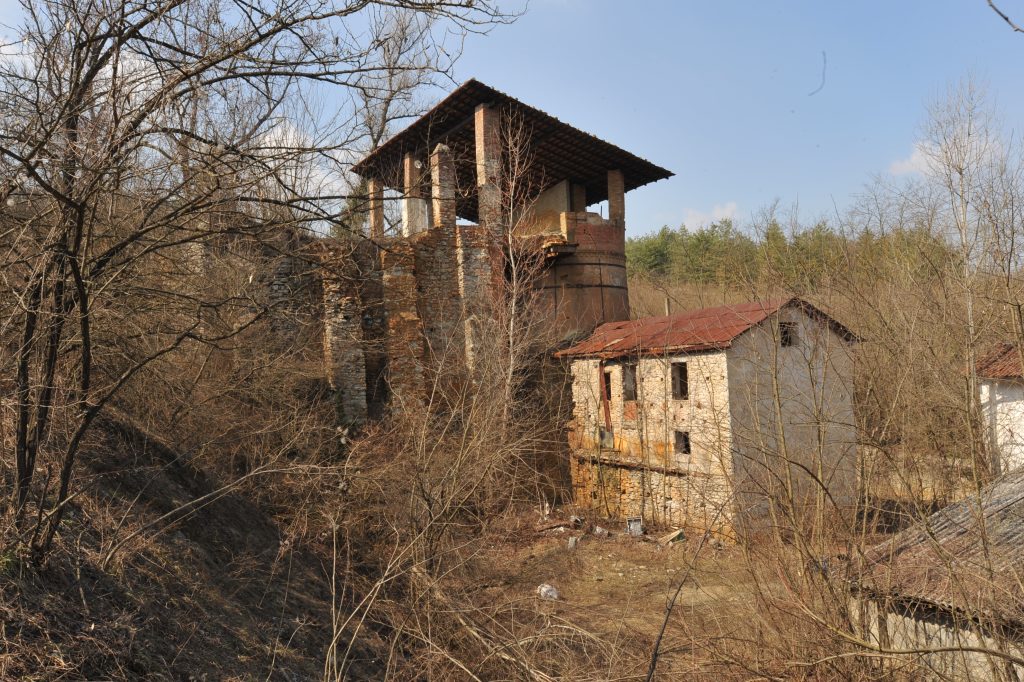
The most interesting and best documented period, also thanks to the industrial remains still visible, is that between 1950 and 1975, with the activity of the Canepa and Zanoletti firms. The Canepa firm plays a special role in the industrial history of Visone, as it was the first company to approach lime production and trade in an entrepreneurial way, beginning to produce and sell on a large scale. Indeed, despite the new railway link, until the end of the 19th century and in the early years of the 20th there was a succession of different firms, each of whose activity lasted only a few years. The lime trade in the Acqui area could not break free from the logic of a local production which, given the plants installed, was not sufficient.
Giuseppe Canepa came from Sestri Ponente, where the Canepa family had traditionally handed down lime production throughout the 19th century and into the early 20th. In Genoa, trading dynamics were already very open to exchange in the 17th century, thanks to the obvious advantage of the sea, an excellent communication route for heavy transport and to distant destinations.
However, the Canepa firm, though more entrepreneurial, never abandoned traditional means of production, which recur throughout its history: the only real departure from even older methods was the continuous-fire kiln. Beyond the modern firing plant and the quality of the explosives, in fact, all the main production operations were carried out by hand and with animal labour. Italian industry had long since mechanised these operations, which Zanoletti had naturally adopted in the neighbouring firm, together with new firing kilns.
In the two decades from 1950 to 1970, two distinct phases in the technological evolution of lime working coexisted and intertwined at Visone, expressed through one production following "artisanal" logic and another, adjacent one promoting new mechanised means of an "industrial" character.
Both firms were forced to cease activity in the 1970s, because of their by then outdated firing systems: the old coal-fired kilns would have had to be replaced by more modern oil-fired ones. Moreover lime, a traditional material, began to suffer definitively from the spread of and competition from cements.


The Tuscan stonemasons of Borgo Villeto
At the end of the nineteenth century, as in many other parts of Italy, work on the construction of the railway attracted labour from other areas. At Visone, popular memory records the presence of a community of Tuscan stonemasons from the Apuan Alps, who settled in Borgo Villeto, a quarter built directly on an old disused quarry terrace.
The documents collected are scarce, but they suggest the presence at Visone of groups of people from Prato and the Pistoia area, a region known for the working of grey pietra serena.
Further reading:
P. Allemani, Le Cave di Visone. Identità territoriale e ipotesi di riqualificazione, degree thesis in Industrial Archaeology, University of Genoa, 2002.
P. Allemani, Gli ecomusei prossimi venturi: il lavoro con la pietra e la calce (Cave di Visone), in "Piemonte Parchi", XX, 2005, no. 4 (April), p. 27.
P. Allemani, Analisi dei processi di degrado della Pietra di Visone ai fini della sperimentazione di nuove tecniche di consolidamento, doctoral thesis, University of Modena and Reggio Emilia, PhD School in Earth System Sciences, Environment, Resources and Cultural Heritage, 2013.
P. Allemani, M. Gomez-Serito, La pietra di Visone: un significativo indicatore per la lettura dell'edilizia storica del Basso Piemonte, in Atti del IV Convegno di Studi Medievali, Florence, 2018, pp. 505-509.
A. d'Atri, Biostratigrafia della Formazione di Visone (Miocene inferiore, Bacino Terziario Ligure-Piemontese), in "Bollettino del Museo Regionale di Scienze Naturali di Torino", 13, 1995, pp. 345-375.
F. Piana et al., Carta Geologica d'Italia at 1:50,000 scale, Sheet 194 – Acqui Terme, 2012.
G. Trabucco, Fossili, stratigrafia ed età del Calcare di Acqui (Alto Monferrato), in "Bollettino della Società Geologica Italiana", XXVII, 1908, pp. 337-406.
From Limestone to Lime
Lime is the first binder in history to be produced artificially by man, obtained through the calcination of limestone.
The oldest known example of the use of lime in building is a Neolithic floor found in southern Galilee, dating back to 7000 BC. Lime came to be used ever more widely in the building activities of the Egyptians, the Greeks and the Romans.
In the medieval period, the technological regression caused by the progressive return to strictly local production brought with it a drastic decline in the quality of lime. The return to large masonry kilns in the 14th century and, above all, the switch from wood to coal as fuel in the 18th century once again made it possible to reach temperatures high enough for complete calcination and thus to obtain products of high quality, already known in the classical age.
More recently, the fortunes of lime slowed progressively around the middle of the last century, when further technological developments and the switch to petroleum-based fuels, with an even higher calorific value, allowed the large-scale spread of cements.
Lately, however, lime has been receiving renewed attention, precisely because of the lower energy requirement for its production and hence its greater sustainability and environmental compatibility.


To obtain hydrated, or slaked, lime, Ca(OH)₂, a further treatment called slaking is required, which in practice consists of adding water to quicklime:
CaO + H₂O → Ca(OH)₂
The slaking process is apparently simple, since it is enough to "wet" the quicklime with water, but the resulting chemical reaction is extremely exothermic, i.e. it releases a great deal of heat. The process is therefore delicate and dangerous and must be carried out with large quantities of water, so that a large mass of water can absorb the heat released without the temperature rising too much.
For this reason, often and especially in the past, slaking was preferably carried out by immersing the blocks of quicklime directly in large tanks, rather than sprinkling them with jets of water.
Slaked lime is a far less caustic and more stable material, although over long periods it too is subject to ageing due to recarbonation.
Its uses are many: for example in leather tanning, water purification, in the chemical, pharmaceutical and petrochemical industries as a reagent and/or additive, or as a milder disinfectant or fungicide. Historically, however, its main use is certainly in building, both as a binder in construction and as an external wall finish, for example in tadelakt.
Lime sets as the final result of three successive stages:
- first, the drying of the mix through evaporation of the water it contains;
- then, the crystallisation of Ca(OH)₂ and the consequent hardening of the mix itself, i.e. the setting;
- finally, starting from the outer layers of the mix, the progressive carbonation of the lime and the expulsion of the so-called "structural water" as well, according to the reaction:
Ca(OH)₂ + CO₂ → CaCO₃ + H₂O
Hydraulic, or pozzolanic, lime is, finally, a variety of lime with added clays, or obtained naturally from limestones already impure through the presence of clayey materials and/or aluminosilicates. It is so called because it has the property of hardening even without contact with air, and is therefore typically used for underwater building work.